With endless sunny days, warm temperatures for most of the year, and amazing volcanic landscapes, Tenerife is an ideal destination for diving and snorkeling. In its waters, vegetation and animals thrive on submerged rocks or within the vast sandy bottoms full of gorgonians.
Ready to explore the depths of the archipelago? The Canary Island is the perfect spot for both expert divers and beginners. The best dive sites are spread across all the towns of Tenerife, from the more touristy south to the wilder north.
In addition, a few sunken ships have become homes for fish and crustaceans.
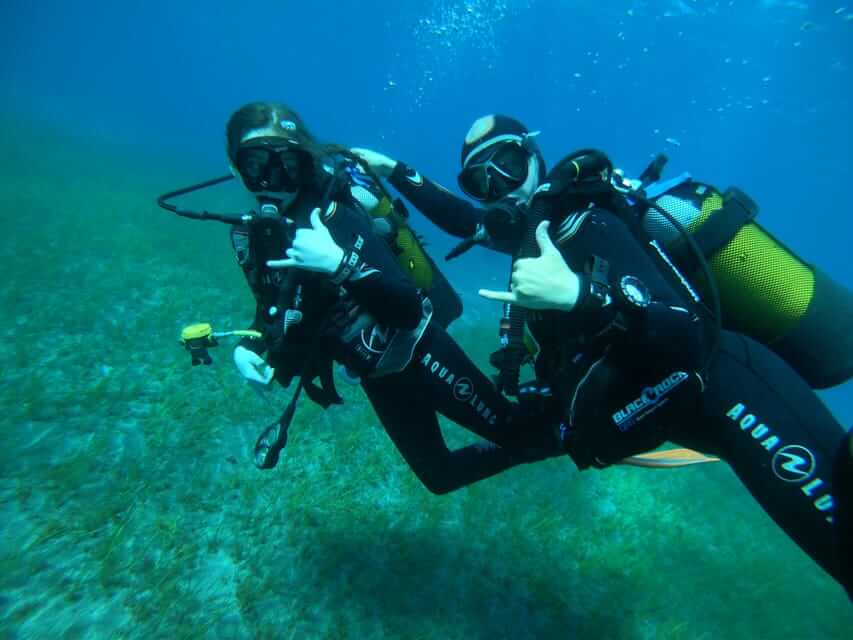
1. Swim with Turtles at Puertito de Armeñine
When you dive into the waters of Puertito de Armeñine, you will see stingrays, angel sharks, starfish, barracudas, trumpetfish, and seahorses—but the real crown jewel is the colony of green turtles. These reptiles usually spend part of the season along the Canarian coast before migrating elsewhere.
The turtles at Puertito de Armeñine are accustomed to human presence thanks to the turtle snorkeling activities carried out in the area, but they should always be treated with the proper respect.
Puertito de Armeñine is a tiny locality in the municipality of Adeje. Although it is just a short distance from the bustling Playa de Las Américas or Puerto Colón, tranquility reigns in this spot.
The white houses by the sea give way to a crescent-shaped black sand beach. This place has been the setting for numerous “diving baptisms” since its shallow bottom is ideal for learning or improving underwater skills.
How to get there?
If your hotel is located in Playa de las Américas, Puerto Colón, or any other town in the municipality of Arona, you will only need about fifteen or twenty minutes by car. Take the Southern Highway (TF-1) in the direction of Santiago del Teide and exit at the Carretera de acceso al puertito (TF-47). Upon arrival, you can park your car in an unpaved lot.
2. Traverse the Volcanic Tube of Garachico
The main attraction of this coastal stretch is the Garachico Tube, a volcanic tube with several chambers inside. The entry point is at 6 meters deep, while the lowest point reaches 25 meters. According to experts, this is the most interesting dive in Tenerife.
Between the basalt columns and the sandy bottom live shrimp, lobsters, trumpetfish, and dozens of other species. If you are a novice diver, it might be best to save this underwater excursion for another time. Since it is a dark place, it is essential to bring a flashlight.
The underwater life is just one of the attractions of this town, which is actually a place rich in history. In the 17th century, Garachico was a very active fishing port. From here, ships loaded with Malvasía wine would set sail for the coasts of England, the main buyer of this spirit. In 1705, the eruption of the Trevejo volcano put an end to Garachico’s commercial vocation: lava flowed to the sea, burying the old town and covering the ships with a thick layer of magma.
The effects of the eruption are still evident today, with the best example being Caletón, an area of natural tidal pools along the ocean. The solidified lava has created a fascinating lunar landscape and underwater rock formations that have become homes for fish and crustaceans.
How to get there?
Garachico is located in the northeast of the island. If you are staying in Los Cristianos or Playa de las Américas, you can reach it by driving on the Southern Highway (TF-1) and then taking the coastal connector road of Daute (TF-42). Garachico is one of the most beautiful towns in Spain and boasts some of the island’s best restaurants.
3. Explore the Wreck of Tabaiba
If you like wreck diving, Tabaiba is your spot. In this town in the north of Tenerife, some diving enthusiasts decided to sink a ship to revitalize the marine life in the area. The chosen vessel was the “R. Peñon,” a tugboat that ended its service in 2006 when it was sunk in a section of sea just a few meters from the shore.
Currently, the ship lies between 18 and 30 meters deep and is very well preserved. To reach the wreck, you simply need to follow a pipe. It’s a short stretch that poses no difficulty for divers; however, inside the tugboat you must be more careful.
The “R. Peñon” is 35 meters long and still retains some of its original features such as the crane and engine room. In the areas that once housed men, you will now find octopuses, trumpetfish, bicudas, jureles, salmonetes, and some large moray eels. Near the wreck of Tabaiba, there is a submerged monument dedicated to Juan Pedro, a diver who used to live in the area. This dive is of moderate difficulty.
How to get there?
Tabaiba is located just a short distance from the Southern Highway (TF-1) and is therefore very easy to reach whether you are traveling from the north or from the busy tourist towns in the south of the island. Once on the highway, simply take exit 10 and drive down towards the ocean.
4. Dive into History in Garachico
In 1797, Great Britain sent a fleet to the Canary Islands with the intention of subduing Spanish defenses and annexing the archipelago. Due to its location, the fortunate islands were a mandatory stop for any ship crossing the Atlantic. It was a highly coveted territory. To achieve this goal, the British crown sent its most prized strategist: Horatio Nelson.
The admiral sailed towards Tenerife with four ships, four frigates, and 4,000 soldiers, while his Spanish counterpart, Marshal Antonio Gutiérrez de Otero, had only 1,700 militiamen at his disposal. Moreover, many of them were peasants, fishermen, and cattle herders from the island. However, Tenerife withstood three assaults, and the Trafalgar hero was forced to return to London without an arm and without having conquered an inch of land.
One of the ships sunk by the Spaniards lies near Garachico. It is the HM Fox, an armed cutter that has remained buried forever in the Atlantic sands. Around it, shrimp, trumpeter fish, Canarian lobsters, and large schools of trumpetfish abound.
How to get there?
If you are staying in Santa Cruz de Tenerife, you should take the Northern Highway (TF-5) to Longueras and then take the TF-42 road. Once there, you can park your car in the lot near Caletón. If you do not have a car, you can use public transportation. Several buses connect Garachico with the main towns in Tenerife.
5. Explore the Twin Wrecks of Los Cristianos
This wreck consists of two vessels—a yacht and a tugboat—that were intentionally sunk to create a habitat for fish and crustaceans. The vessels are 25 meters apart and lie at a depth of 20 meters. Not far away, a statue of a woman stands guard over the area.
Everywhere you look, you will see schools of amberjacks, cuttlefish, and octopuses. Lizardfish, anemones, and fireworms complete the marine fauna. The fireworm, in particular, is very common in the archipelago and deserves a special mention. When it feels threatened, the fireworm extends its stinging setae and releases a substance that causes significant pain. Be careful and try not to get too close.
Due to its shallow depth and lack of currents, this dive can be undertaken by divers of any level. Underwater, visibility is usually moderate: if you’re lucky, you may find crystal-clear waters, but occasionally the sandy bottom gets stirred up, making movement a bit tricky. In these cases, it is best to bring a torch.
How to get there?
The Twin Wrecks are located near Puerto Colón, the quintessential tourist area of Tenerife. Being in such a busy area, you will find dozens of tours organizing diving excursions. Keep in mind that this dive site can only be accessed by boat. If you’re interested in these excursions, you can check out the article “The Best Boat Cruises around the Island of Tenerife.”
6. Be Amazed by La Rapadura
In Tenerife, the most stunning underwater landscape is found on the coast of Acentejo. Deep in the Atlantic lies a volcanic reef with unique hexagonal structures. These geometric shapes are not a man-made phenomenon; they were formed thousands of years ago when basalt lava flows reached the sea. The result is a huge submerged structure that looks like an abandoned palace or a grand organ.
La Rapadura is an incredible dive site—so much so that in 2012 National Geographic magazine dedicated a report to it. Unlike other coastal areas, here flora and fauna are sparse. The only living forms are a few sponges, gorgonians, and schools of bullet corals. The dive reaches a depth of 45 meters and is reserved exclusively for expert divers. Moreover, this underwater cathedral can only be visited under suitable tidal and current conditions.
How to get there?
La Rapadura is located three nautical miles from the Port of La Cruz and its hidden treasures can only be accessed by boat. If you are interested in the excursion, you will find dozens of tours departing from Puerto de la Cruz or other towns along the Acentejo coast. This site is located near the town of Santa Úrsula, close to the cliffs of La Quinta.
7. Dive at the Foot of the Montaña Amarilla
Montaña Amarilla is a hill formed by volcanic ash in yellow tones and shaped by the erosion of wind and water. This dive site is located in a nature reserve and features a stunning underwater landscape.
The white sandy bottom is sprinkled with channels, caves, and formations of solidified lava. In this stretch of coast, you often find torpedoes, scorpionfish, rays, and long-tailed guitarfish—a type of stingray that lives in the Canarian archipelago. In these crystal-clear waters, trumpetfish also abound.
At Montaña Amarilla, the depth varies between 6 meters and 26 meters; therefore, it is a dive suitable for all levels. You have two options for entering the water: via platforms with ladders or directly from the beach. In my opinion, the first option is preferable since this area is generally not affected by currents.
How to get there?
From Santa Cruz, take Avenida Marítima (TF-11) then the TF-4 motorway and finally access the Southern Highway (TF-1). Drive approximately 70 km, take exit 62, and follow the signs for San Miguel. You can park your vehicle in a lot near the beach.
8. Discover the Lush Marine Life at the Punta Rasca Lighthouse
This dive usually begins with a vertical descent. Upon reaching a depth of 20 meters, you will see tunnels and stone arches formed by solidified lava. Anemones flourish on the rocks, using their tentacles to capture the myriad invertebrates and small crustaceans that inhabit this coastal stretch. In general, what stands out is the abundance of fish.
With a bit of luck, you might spot frogfish camouflaging against the sandy bottom and perhaps even a specimen of the spiny gurnard, a porcupine fish with a placid behavior that is often mistaken for a pufferfish. In the tunnels, crabs, cleaner shrimp, prawns, and Canarian lobsters thrive. This coastal area is subject to strong winds and currents. With the tidal movements, the dive can become somewhat challenging, so it is not recommended for novice divers.
The Arona or Punta de Rasca Lighthouse is the southernmost of all the lighthouses in Tenerife. The area, known as Malpaís de la Rasca, is a natural reserve crisscrossed by dozens of trails. Every week, tourists and locals flock to this place to enjoy nature and admire the beautiful views of the ocean.
How to get there?
To reach the Punta Rasca Lighthouse, you will need to walk several kilometers. This lookout, with its typical red and white stripes, is located in a vast natural area with no way to park your car near the coast. If you want to dive in this environment, the ideal option is to choose a boat excursion from the nearby town of Las Galletas.
9. Descend the Three Levels of El Bufadero
El Bufadero is a dive site with great biodiversity and three distinct depth levels. At five meters below the surface, you will find trumpetfish, cuttlefish, octopuses, and, above all, the queens of the Canaries: the green turtles. These creatures prefer temperate, tropical, and subtropical waters and are distinguished from other turtles by their prefrontal scales. Green turtles live in shallow, vegetation-rich waters because they feed on algae, jellyfish, and small crabs.
At 15 meters deep, the rocky bottom is home to wrasses, shrimp, anemones, and diadema sea urchins—a species characterized by their very long black spines. Also known as the Lima urchin, it is an invasive exotic species that has become a threat to the archipelago’s ecosystem.
Finally, at 25 meters deep lies an extensive sandy area where the elongated bodies of garden eels peek out. Here you can also admire rays, napoleon wrasses, and large schools of amberjacks.
El Bufadero is the ideal place to swim with turtles. It is an easy dive that can even be undertaken by novice divers. The area is not subject to strong marine currents, and therefore it is not difficult to enter the water from a boat. The southern coast of Tenerife is sheltered from the trade winds, making it easy to find calm waters with good visibility.
How to get there?
El Bufadero is located near Playa de San Juan, a town in the municipality of Guía de Isora. This town is about a 20-minute drive from Los Cristianos. To get there, simply take the Southern Highway (TF-1) in the direction of Santiago del Teide. You can also opt for public transportation; several buses connect Playa de San Juan with Los Cristianos.
10. The Cathedral: An Almost Religious Underwater Experience
The north of Tenerife is the wildest part of the island, and near Puerto de la Cruz you will find one of its most astonishing dive sites. I’m, of course, talking about the Cathedral—a rocky massif that reaches depths of up to 40 meters. Diving in these waters means admiring an impressive volcanic landscape dotted with vaults, caves, arches, and forests of gorgonians.
From the bottom, a chimney rises to a depth of 18 meters. Here you will find surprising marine life: groupers, sardines, crabs, and scorpionfish, curious fish with reddish and yellowish scales. In the darker areas, moray eels abound and, if you feel like it, you can even stroke them as they are used to human presence.
Due to its depth, only advanced divers can descend to the bottom. Novices should stick to the first level—around 20 meters. In any case, you
will need to pay attention to the currents that affect this coastal stretch. As for visibility, it is usually good since marine fauna and flora can be seen down to 30 meters deep.
How to get there?
This dive site is located just in front of the pier in Puerto de la Cruz. Despite its short distance from the coast, dives are generally conducted from a boat. If you are not staying in Puerto de la Cruz, there’s nothing to worry about. As a municipality with a long hotel tradition, it is very easy to get there from any point on the island.
Best Diving Tours in Tenerife
- Beginner Diving
An ideal tour for those who wish to start diving. It includes a theoretical session, practical training in shallow waters, and a supervised dive with certified instructors, ensuring a safe and educational experience. - Advanced Diving Experience
Designed for experienced divers looking to explore deeper and more challenging sites. These trips usually include dives in areas with interesting volcanic formations, shipwrecks, and varied marine habitats. - Combined Snorkeling and Diving Tour
Perfect for those who want to enjoy a dual experience. It begins with a snorkeling session to observe marine life on the surface, followed by a guided dive that allows you to venture into the underwater world. - Shipwreck Diving Excursion
A unique adventure to explore sunken wrecks and shipwrecks, where you can admire colonies of fish and natural formations on the seabed, shaped over time by nature. - Night Diving
A magical experience to discover underwater life under the glow of the night. This tour reveals behaviors and species that are only visible in the dark, offering a completely different perspective of the marine environment. - Diving Tour with Underwater Photography
Especially designed for photography enthusiasts, this tour combines guided dives with techniques and tips for capturing stunning images of the underwater world. - Boat Excursion for Multiple Dives
An option that allows several dives in a single day. Ideal for those who wish to explore different points of interest in the waters surrounding Tenerife, all with the support and safety of a professional crew.
These activities reflect the diversity of experiences available in Tenerife, allowing you to choose the option that best suits your level and preferences. From relaxing dives in crystal-clear waters to exciting adventures in unique natural settings, each tour is an opportunity to connect with the island’s fascinating underwater world. Get ready to dive in and discover everything Tenerife has to offer!